
From the archives: In 2021 editors at The Conversation (Australia) asked academics to describe where they would rather be if not locked down in their homes in Sydney or Melbourne. My thoughts took me back to a small village in England where I had spent many happy summers. This version of the text is the original I submitted.
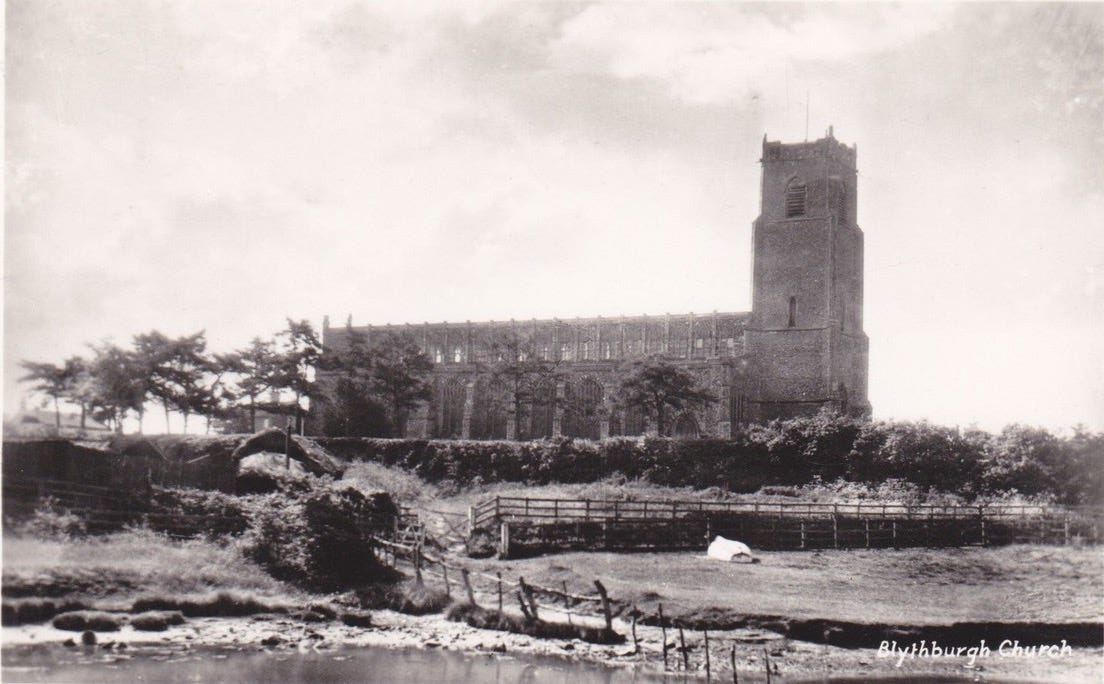
A church, an ancient heap of flints, rises up, cavernous, through mist and marshes. The “Cathedral of the Marshes”, they call it. This is Blythburgh on England’s windswept Suffolk coast.
The landscape here is oppressive, bleak. What man once made is quickly being lost to nature: sea erodes land.
The nearby parish at Easton Bavents fell beneath the waves centuries ago. Bare traces remain of the great medieval port of Dunwich five miles south.
Yet Blythburgh’s Holy Trinity stands tall, majestic even, a near-perfect expression of a mature perpendicular style.
East Anglia is dotted with such archaic oratories, which claim a remarkable hold over the English psyche. These churches are our public monuments, as Simon Jenkins has noted. But they are also memory palaces that enshrine a thousand years or more of history.
Names, dates, materials, shapes: they link us to lives, tastes, communities and faiths of the long forgotten. To visit such a place is to do more than admire. It is to commune with the past, marvelling in its reinvention as a foreign country and at how far we ourselves have come.
Far from the madding crowd
I used to visit Blythburgh as a kid. My Dad liked it here: the lonely desolation a tonic for the hustle and bustle of Cambridge’s university life.
His love of churches inspired me. In Ely and St Edmundsbury we went to cathedrals together. At Orford and Long Melford he showed me the brasses and stained glasses.
But Blythburgh’s impression on me was always greatest. It had atmosphere — that intangible je ne sais quoi that comes from time and place and feeling.
Blythburgh’s mien is wistful and melancholy, the result of centuries of diminishing relevance and (mostly) benign neglect.
This sort of place inspired Benjamin Britten to opera and M. R. James to ghost stories. After all, the set of Peter Grimes and “A warning to the curious” is just a hearty walk away along the coast.
The magic here is that you are never quite sure you are truly alone, however drab or empty the space might seem. Another James story, “Oh, Whistle, and I’ll Come to You, My Lad” tells of an encounter on one of the beaches round about. The protagonist, a young professor, finds a little bronze object which he blows. The rest is all chasing and shadows: pure Gothic horror.
As a kid, the tale terrified me.
Watched over by angels
A church first stood in Blythburgh before 654 CE. That was the year King Penda of Mercia slaughtered King Anna of East Anglia and his son in battle. Anna’s followers brought their bodies here for burial.
The present building is mostly 15th-century. In this part of England those days were what Evelyn Waugh called the fat days of wool shearing and the wide corn lands.
Nearly all the current plan was laid out then: the languid nave, capacious chancel, memorial chapels in the aisles, benches, monuments, font and the immense high-beamed roof.
That roof: it protects the congregation from more than just the elements. A throng of angels, their faces serene but their wings aflutter, stand guard over those who sit on pews below.
The pews themselves are works of art, with carved poppy heads parading saints and seasons, works of mercy and sins personified.
Here, Slander brandishes his tongue, Gluttony his paunch, Hypocrisy his false piety and Sloth his bedgown. There, a man comforts the sick, another visits a prisoner, a third buries his dead.
This kind of delicate, intricate carving demanded the highest skill possessed by medieval craftsmen.
Other churches have their own sacramentals, but Blythburgh’s are amongst the most beautiful and haunting. Spartan white walls and a clear, clean glass clerestory — the bandages of Reformation trauma? — only enhance the effect.
Blythburgh’s decline has been a long time in coming. The Reformation, an early blow, destroyed the priory which abutted the church.
The tower’s steeple fell in 1577 and its lack of resurrection somehow seems to symbolise this part of Suffolk’s gentle retreat thereafter into bucolic backwater.
In the 1640s, “Smasher Dowsing” and his men attacked the church’s art and icons, stripping the roof of half its angels. A parochial itch to shoot at jackdaws nesting in the rafters may have caused further damage in the 18th century.
Victorian antiquaries restored the place to something of its former glory. But today, few come to worship in Blythburgh’s paludal “cathedral”.
The village itself houses just 300 souls and the locality, in the hinterland of a bird sanctuary, is best known as a haven for sailboats and as a twitchers’ paradise.
Inside the tower, a sombre armoured Jack-o-the-Clock from 1682 still keeps time. His baleful inscription: “As the hours pass away, So doth the life of man decay”.
The church, which has borne silent witness to countless other plagues, disasters, and wars, endures even now in its gloomy spot.
I glimpse it still from half a world away, an eerie greyness cloaking it with a salt wind from the sea.
First published by The Conversation, 24 June 2021.