
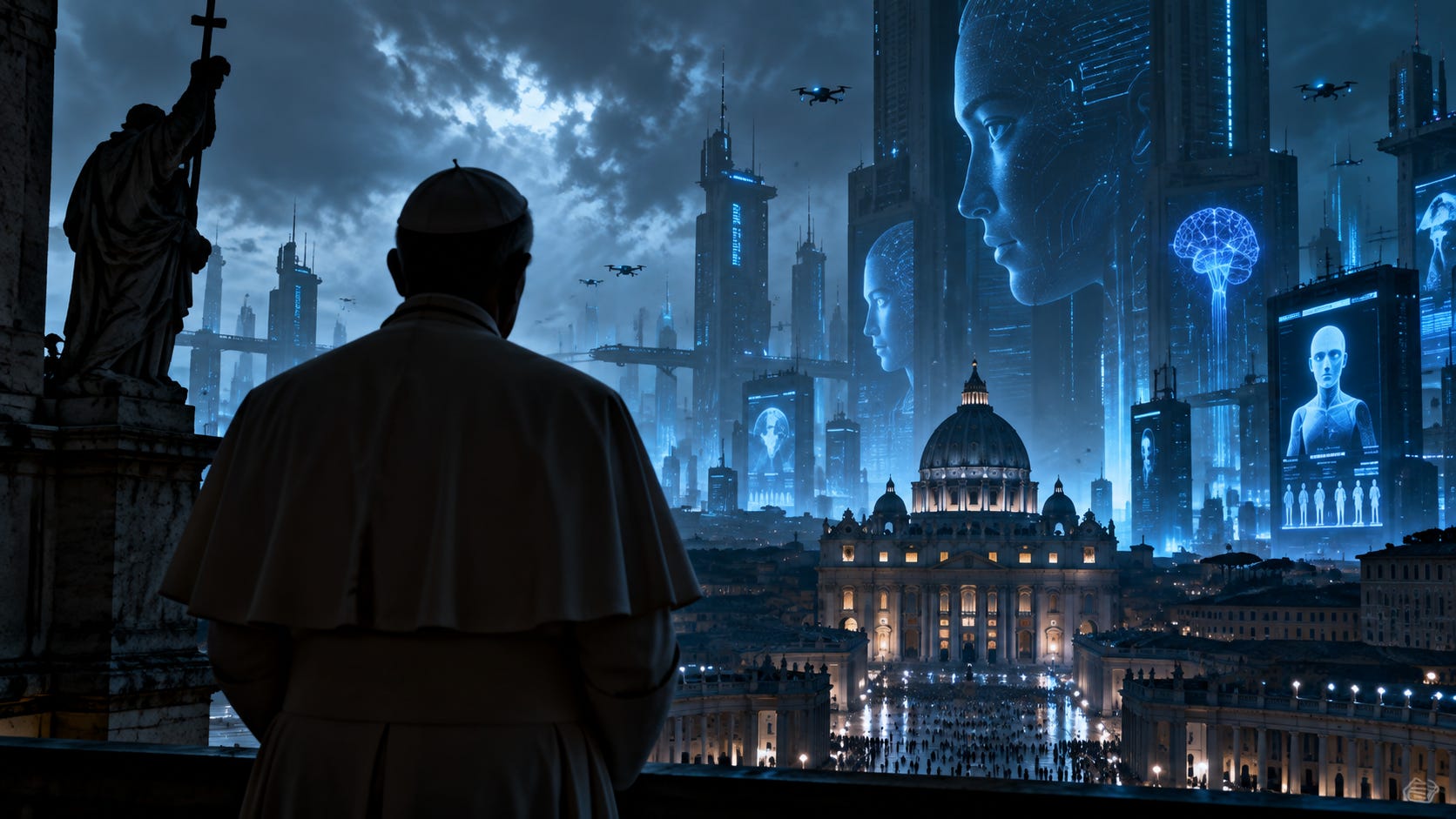
In the Vatican’s New Synod Hall, Pope Leo XIV appeared last week alongside Anthropic co-founder Chris Olah. The two men probably do not agree on many things, but this time they spoke in concert about the urgent threat AI now poses to humanity. But Leo’s new encyclical Magnifica Humanitas is not simply a warning about the coming of the machines. It attempts to insert Catholic intellectual traditions into the emerging debate over our age’s most contested technology.
The encyclical is, above all, about authority: Who gets to define the human?
A civilisation that measures everything, and that values only what can be measured, will eventually lose the capacity to recognise the human, the divine and the ineffable, the pope contends. He fears that moral universalism cannot easily survive technocracy — but it needs to if human dignity, conscience and compassion are to flourish yet.
Magnifica Humanitas raises the institutional stakes. It commits the Catholic Church formally and publicly to a set of positions about artificial intelligence (AI) that can now be held up, examined and weighed against the institution that proclaimed them.
The church wants a seat at the table, for a papal encyclical is a geopolitical act as much as it is a theological document. But, in this case, it is also a personal statement that tells us about the pope himself as much as it is about its purported subject: who he thinks he is, how he wants his papacy to be seen, and whom he wants to influence.
Babel or Jerusalem?
What, then, does Leo say in Magnifica Humanitas? The name of the encyclical evokes Mary’s song of praise (Luke 1:46–55) and does so in a way that is quietly subversive. A text about who controls God-like technologies echoes a prayer in which the Lord casts the mighty from their thrones and sends the rich away empty.
The pope’s chief argument in Magnifica Humanitas is that humanity needs a new framework for approaching AI’s ethical dimensions. We should be asking how we govern it and make it accountable, how we guarantee the dignity of work in the face of its advance, and how we preserve truth and democracy, prevent warfare and critique what Silicon Valley calls “transhumanism”.
As humans, Leo insists, our choice is not whether we embrace technology — that’s a done deal. It is how we do so: Quis custodiet ipsos custodes , “Who guards the guards themselves”? Regulation of AI is currently in the hands of the few. Should it be permitted to remain there or must we find a way to ensure that it is organised according to subsidiary principles that benefit everyone?
Leo offers up a pair of biblical models to help us discern the choices. His first model is Babel — a civilisation that builds for power and uniformity, but which reduces everything, including persons, to data and performance. Its citizens mistake efficiency for wisdom. Leo’s second model is Jerusalem under Nehemiah — a city rebuilt not by a single visionary but by patient, communitarian collaboration. As he writes:
In the abstract, technology in and of itself is not a solution to humanity’s problems, just as it is not inherently evil. In practice, however, technology is never neutral, because it takes on the characteristics of those who devise, finance, regulate and use it. Therefore, the primary choice is not between a “yes” or “no” to technology, but rather between constructing Babel or rebuilding Jerusalem; between a power that claims to dominate the heavens and a people who work together in the presence of God to rebuild the walls of fraternal coexistence.
Every human being is made in God’s image. This proves a critical point of departure for thinking about what machines can and cannot do for us. Because the dignity we each possess is intrinsic, no algorithm can measure, rank or revoke it. AI systems that sort and exclude us without possibility of appeal are not only unfair but also commit a category error.
He insists that AI cannot be considered morally neutral. In any case, “a more moral AI” would still be insufficient if that morality lacked genuine democratic participation in the construction of its frameworks. An “ecology of communication” needs to be established so that truth is treated as a common good rather than a resource to be weaponised. Likewise, autonomous weapons systems must not be allowed because the decision to use lethal force “cannot be delegated to opaque or automated processes”. And transhumanism — the idea that human limitation is a defect to be engineered away — is not merely misguided but a denial of the very humanity it claims to perfect.
In short, a civilisation that optimises away its imponderables will find, too late, that it has also surrendered its ability to thrive.
The encyclical’s historical imagination
It is no accident that Leo signed his text on 15 May, the 135th anniversary of the Leo XIII’s celebrated encyclical Rerum Novarum, which is Catholic Social Teaching’s foundational document. Leo has already sought, through the selection of his name, to link himself to that earlier pope who intervened in the face of an Industrial Revolution that had reduced workers to the status of units of capital and production. The analogy is imperfect. Industrial capitalism mechanised labour, but AI may yet mechanise elements of cognition itself.
Everything that follows in Magnifica Humanitas flows from that self-identification. Leo XIII was arguably the most consequential pope of the modern era — the man who created “the pope” in his present incarnation as a voice of conscience for humanity. By casting himself as Leo XIII’s direct successor, Leo XIV signals both that he believes the world to be entering an equivalent moment of transformation and that he is equal to the task of guiding the church through it.
What Magnifica Humanitas omits may nevertheless be as interesting as what it includes. Its historical imagination, for instance, is surprisingly limited. Textual references cluster in just two periods: biblical antiquity and the years since Rerum Novarum. In the account of Magnifica Humanitas, essentially nothing happened between Nehemiah in the fifth century BC and the Industrial Revolution of the nineteenth. Augustine garners just four references in the text and Aquinas two — placing him just above Hannah Arendt and JRR Tolkien’s Lord of the Rings, which receive one each.
It might be conceded that Leo’s encyclical has an essentially Thomist framework, but the absence of Duns Scotus or other key figures in the scholastic tradition that generated much of the speculative theology which it deploys is striking.
The Babel-Jerusalem duality also discreetly glosses over the fact that the Catholic Church itself has been one of history’s most enthusiastic Babel-builders when its interests have been at stake. After all, until 1966 it maintained a list of books whose circulation it considered too threatening to permit.
Magnifica Humanitas does not address the church’s reaction to the Printing Revolution of the sixteenth century or to the Scientific Revolution of the seventeenth. Perhaps this is understandable — though one wonders what Galileo’s ghost would make of it all — yet both “revolutions” precipitated precisely the sort of soul-searching Leo now reserves for AI.
We might observe that the Catholic Church has often engaged with new technologies in a consistent sequence: first resistance; then attempted control; followed by strategic adoption; and finally theological integration. Leo’s text arguably moves that sequence for AI closer to its endpoint. But it does not necessarily follow that his interlocutors in Silicon Valley or secular government will accept an agenda on his terms.
Amen to the algorithm
Perhaps the most intriguing question about Magnifica Humanitas is one about audience: For whom is this encyclical written?
Yes, the pope has written it for the Catholic faithful, as is the case with all encyclicals, but this time he clearly has an eye on non-Catholics too — specifically, those non-Catholics who form Silicon Valley’s core of innovators and safety researchers, as well as those who populate the global governing class’s regulatory caste.
Leo’s choice of references seems almost tailored to speak to the progressive sensibilities of these groups. Not only does he refer to The Lord of the Rings — the tech geek’s Old Testament, if you will — but he notably and carefully acknowledges the Catholic Church’s slowness in condemning slavery, an original wickedness that reduced persons to “manageable” data.
Even the staging of last week’s event showed Leo’s awareness of appropriate presentation. Two women — theologian Anna Rowlands and theological ethicist Léocadie Lushombo, the latter a person of colour from the Global South — sat alongside Cardinal Víctor Fernández, Prefect of the Dicastery for the Doctrine of the Faith, Cardinal Michael Czerny, Prefect of the Dicastery for Promoting Integral Human Development, and Cardinal Pietro Parolin, the Vatican’s Secretary of State. This was not merely the stale, pale, male Vatican of old.
Leo knows his audience, but will they listen to him? The history of papal social teaching may not seem encouraging on this point, for it is largely one of admirable statements and selective engagement. Rerum Novarum did not stop the exploitation of labour. More recently, Francis’s 2015 encyclical Laudato Si’ did nothing to slow down the carbon economy.
And yet there is hope for the pope. There is a suggestion being put about that in the encyclical Leo is specifically rebutting Peter Thiel, the conservative tech billionaire who reportedly told Vice-President JD Vance to ignore the pontiff on AI ethics. Thiel has spoken of mortality as an injustice to be overcome rather than a condition to be sanctified, and about “transhumanism” in precisely the terms that Leo’s encyclical confronts.
At a broader level, the “Minerva Dialogues” — annual closed-door conversations between Silicon Valley and the Vatican — have for ten years now attracted important non-Catholic figures who take a different view to Thiel. Such tech titans recognise that Christianity provides something their start-ups alone cannot: a framework for discussing what is humanly desirable, not simply what is technically possible.
It seems AI is already biased in favour of Catholic moral reasoning. Perhaps that is why Chris Olah, an atheist, consulted Catholic priests and theologians when drafting his model’s ethical constitution — its so-called “soul doc”. Olah and others may well have to listen to Pope Leo even more attentively in the future, because AI is haemorrhaging public trust and its prophets in Silicon Valley are already being compared to an unaccountable priesthood.
If so, Magnifica Humanitas could prove to be techno-capitalism’s baptismal moment.
Postscript: The AI Inquisition
It was perhaps inevitable that self-appointed AI investigators are now claiming that significant portions of Magnifica Humanitas were generated by artificial intelligence. Linch Zhang and Daniel Filan have analysed its word frequencies, punctuation usage, sentence rhythms and rhetorical structure. According to Zhang, Magnifica Humanitas differs notably from previous encyclicals in how it performs under AI detector scrutiny. While some of its paragraphs appear to be wholly human in construction, others are flagged as entirely artificial — written by Claude, Zhang thinks.
On one level, these claims are frivolous. At another, they make Magnifica Humanitas a live demonstration of its own thesis. Pope Leo warned that we are entering a world in which we can no longer distinguish authentic human expression from its synthetic imitation. And here we are, unable to verify his very words. The irony is heaven sent.
The encyclical’s collaborative nature may, in fact, exonerate Pope Leo himself from accusations of wrongdoing. Magnifica Humanitas, like most such documents, is a team effort, with Leo likely exercising overall oversight. He stands at greater risk of criticism not because some subordinates “cut corners” by using Claude, but if it comes to be thought that he endorsed any use of a chatbot to substitute the labour of his team of human ghostwriters. Automating away Catholic theologians is precisely the kind of thing his own encyclical warns against.
And yet in a final twist, someone has since fed the encyclical back into Claude AI. The chatbot came up with a lengthy list of theological objections and philosophical errors in the text which it thought might have raise eyebrows at the Congregation for the Doctrine of Faith. Not even the pope expects the AI Inquisition, apparently.
First published on ABC Religion & Ethics, 1 June 2026.