
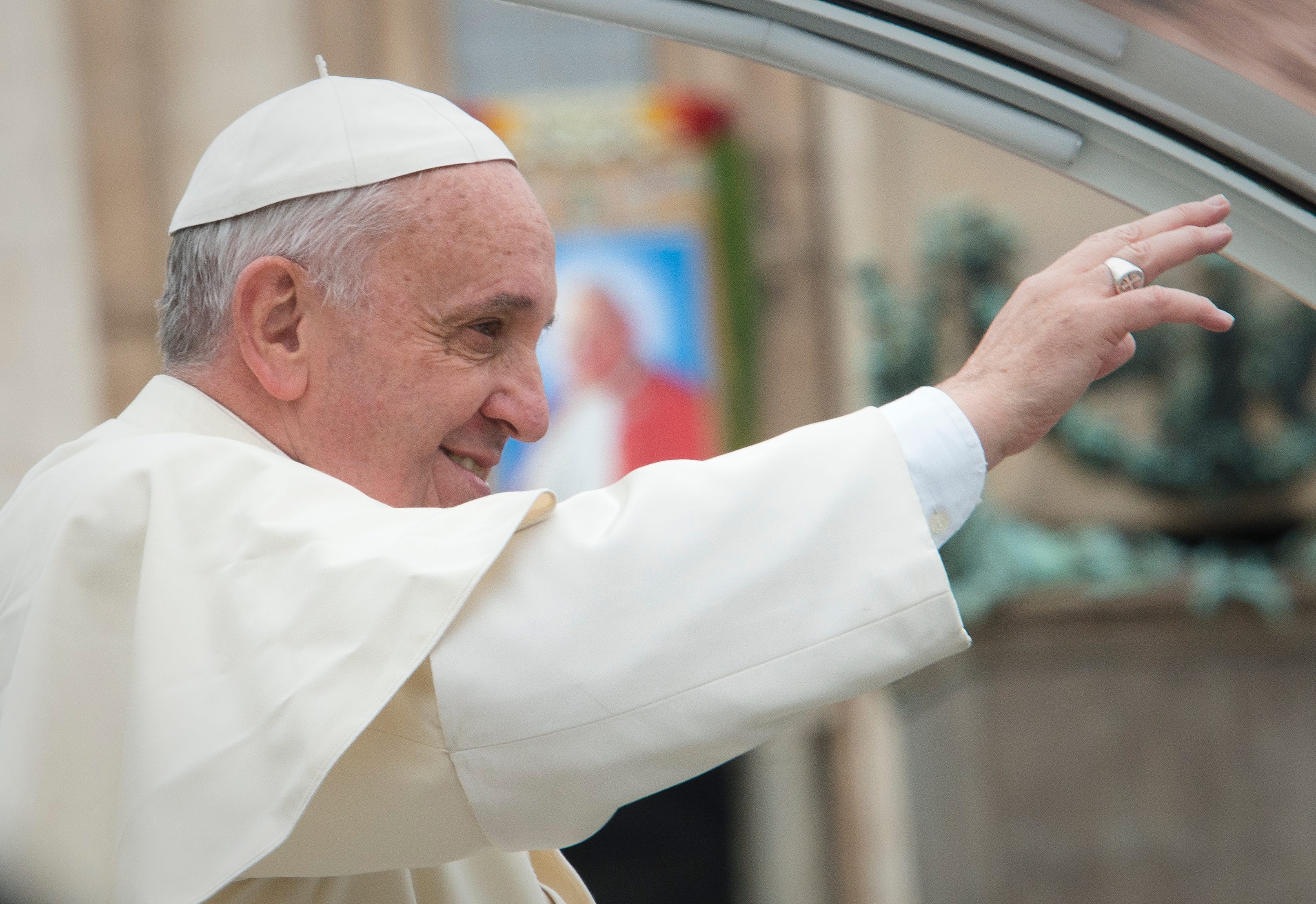
Pope Francis (17 December 1936 – 21 April 2025), that unexpected but much anticipated first pope from the Global South, was a new kind of pontiff. He was an anti-pontiff. An Argentinian from humble origins — his father was an Italian immigrant accountant — he set store by the power of simple gestures, surrounding himself with children, reaching out to the sick and destitute, and giving up his grand papal apartments in favour of a simple life in the Vatican’s Domus Sanctae Marthae guest house.
Few who saw them will have forgotten the various episodes in his life that went viral: the little boy whom Francis let sit in his papal chair; the time he approached a man disfigured with neurofibromatosis to embrace and kiss him; his lonely walk through St Peter’s Square during the COVID-19 pandemic to pray for the world.
Through such gestures Francis won himself a global fanbase that extended far beyond practising Catholics. To the world’s media he was a “people’s pope”, the very model of a modern man of faith who seemed capable of transcending politics, healing division and leading by example in ways that secular figures could not.
Care for our common home
Francis was the first ever Jesuit pope, but he devoted his papacy not to his Society but to the thirteenth-century mystic Francis of Assisi.
Saint Francis had already inspired countless as an uncomplicated man devoted to God, the poor and to nature. He famously appeared naked before his local bishop in an effort to persuade him of his sincere desire to live in “holy poverty”. He talked to the birds in the trees and urged them to sing God’s praises.
Likewise, Pope Francis made simplicity and humility his trademarks. He presented himself as a sort of “anti-pope” who championed the downtrodden and who rejected pomp and flummery. He preached a powerful message of tolerance — for example, “Who am I to judge?” was his celebrated response to a question about gay Catholics in 2013. He also hinted at major shifts in the Vatican’s position on sexual ethics, abortion and women’s ordination. Indeed, his 2016 letter Amoris Laetitia (“The Joy of Loving”) and his 2020 encyclical Fratelli Tutti (“We are All Brothers”) set out a powerful philosophical argument for such shifts.
In the end, however, Francis was unable to deliver very much. The Catholic Church’s official teaching has remained much as it was at the start of his pontificate, with only minor concessions to women’s place in the Church’s formal life. The much-hyped Synod on Synodality (2021–2024) — perhaps intended to test the Church’s temperature and willingness to reform — has little to show for it. Part of the problem was that Francis was acutely aware of the need to generate consensus. As pope, he could lead but he had to be sure others would follow.
So too it has been in other areas of policy close to Francis’s heart. His encyclical letter Laudato Si’ (“Praise be to you”, a title taken from Saint Francis’s Canticle of the Sun), and its follow up Laudate Deum (2023), embraced a deeply ecological outlook. They exhorted humanity to “care for our common home”. Yet governments and citizens alike have moved on, looking increasingly to mitigate climate change not to prevent it. Sadly, Francis never got around to saying much about this.
The pope and his critics
Francis’s failures to act, or to keep pace with the global conversation, sometimes played into the hands of his conservative critics. He was less a people’s pontiff, they said, than a priestly incarnation of that fairy-tale emperor whose “new clothes” turned out to be no clothes at all.
Such critics — and Australia’s Cardinal George Pell ranked first among them — pointed to the increasingly chaotic and corrupt nature of the Vatican under Francis’s watch, to his own allegedly controlling tendencies, and to his support for key lieutenants who put people’s backs up or were just generally incompetent.
One such lieutenant, Cardinal Giovanni Angelo Becciu, was accused of embezzlement, abuse of office and subornation. Becciu’s spectacular fall in 2020was a monumental scandal that embarrassed the Vatican. The repercussions are still being felt to this day, in part because the justice meted out never quite shrugged off the appearance of a show trial. Financier Raffaele Mincione, moreover, tried to sue the Vatican in London’s High Court for what he alleged to be its unfair treatment of him in the affair.
The harassment of priests and bishops who wished to celebrate the old Tridentine Rite Latin Mass, which was previously encouraged by Pope Benedict XVI, also looked vindictive and quickly became another source of angst and tension. Francis was clearly annoyed, even angered, by subordinates who critiqued him too strongly on this matter. His frustration occasionally burst out into pejorative language that was unworthy of a pope. “There’s already too much faggotry around”, he is alleged to have said about the Church’s propensity to attract “liturgy queens” — a statement that stands in marked contrast to his earlier willingness to suspend judgement about homosexuality.
The pope’s difficult cases
More troubling, for the pope, was the case of the Marko Rupnik, a Jesuit priest accused of abusing multiple women. Francis stood accused of having protected Rupnik for a long time, which further tarnished him in the eyes of his detractors. At what cost to Rupnik’s victims and to the Church’s reputation? Much like the case of Becciu, the pope either failed to get a grip on what was happening beneath his nose or, far worse, was somehow complicit in the concealment.
The cases of Becciu and Rupnik represented two of the most explosive scandals of Francis’s twelve-year pontificate — but there were others. The Vatican had known of accusations against Theodore McCarrick, Cardinal Archbishop of Washington DC, for decades before Francis’s election and yet had decided not to investigate him. However, the case exploded on Francis’s watch. Francis denied knowledge of the allegations against McCarrick and subsequently defrocked him, ordered an investigation into the scandal and made its findings public.
Francis also attracted criticism for his responses to credible allegations of abuse and cover up involving the Argentinian bishop Gustavo Zanchetta, and the Chilean priest Fernando Karadima and bishop Juan Barros. In his defence, the pope faced a very difficult situation when dealing with such cases. He knew that he could not always act on accusations, let alone rumours. He generally strived to show empathy and compassion for abuse victims, to show that he understood and accepted their trauma.
Francis also exhibited his trademark humility throughout his pontificate. “All I am trying to do is advance the Gospel”, he once said. “But imperfectly, because sometimes I make mistakes.” This change of tone was particularly important in the context of clerical sexual abuse. Such remarks, and the sentiment they contained, often allowed Francis to win the benefit of the doubt from international media. They were the opposite of the bombastic claims to infallibility made by his nineteenth-century predecessors.
But the relatively easy ride that Francis got from the media annoyed many conservatives. They argued (not without basis) that Pope Benedict XVI had not received the same treatment — indeed, that he had often been unfairly held personally responsible for everything that happened between 2005 and 2013.
For his part, Francis only compounded the issue by sometimes failing to think through the implications of his willingness to show intent through symbolic action. One example of this occurred when he went to Canada to apologise for the Catholic Church’s role in abusing indigenous children in residential schools. Francis’s intention was good but the narrative of genocide of native children, for which he apologised, was always open to reasonable doubt.
The pope as a geopolitical actor
In his final years, Francis had to contend with a deteriorating geopolitical situation. Here too he lived his mission to speak up for the poor, weak and vulnerable. His stridency as a critic of Israel was not, however, matched by a similar lack of equivocation towards Russia following Vladimir Putin’s invasion of Ukraine. Many Catholics noticed.
Francis’s criticisms of Israel focused on a justified humanitarian concern for Gaza’s civilian population after Hamas’s 7 October 2024 terror attack against ordinary Israelis. An excerpt from his recent memoir drew attention to the opinion of some international law experts that “what is happening in Gaza has the characteristics of a genocide”. In January 2025 he went still further, calling the situation:
very serious and shameful … We cannot in any way accept the bombing of civilians … We cannot accept that children are freezing to death because hospitals have been destroyed or a country’s energy network has been hit.
Though Pope Francis was visibly and vocally concerned for the fate of those hostages taken by Hamas, Israel’s Foreign Ministry admonished him repeatedly for such one-sided remarks. They felt Francis never seemed to have engaged with the Israeli government’s claims that it has taken reasonable efforts to avoid civilian causalities, to say nothing of the role played by the reckless indifference of Hamas in the ongoing atrocities.
Even so, it is notable that Francis’s final Urbi et Orbi message on Easter Sunday would call for an end to this conflict:
I would like us to renew our hope that peace is possible! From the Holy Sepulchre, the Church of the Resurrection, where this year Easter is being celebrated by Catholics and Orthodox on the same day, may the light of peace radiate throughout the Holy Land and the entire world. I express my closeness to the sufferings of Christians in Palestine and Israel, and to all the Israeli people and the Palestinian people. The growing climate of anti-Semitism throughout the world is worrisome. Yet at the same time, I think of the people of Gaza, and its Christian community in particular, where the terrible conflict continues to cause death and destruction and to create a dramatic and deplorable humanitarian situation. I appeal to the warring parties: call a ceasefire, release the hostages and come to the aid of a starving people that aspires to a future of peace!
Francis was also one of the world’s most outspoken critics of Donald Trump and his presidency. An extraordinary (but perhaps ill-judged) letter sent to American Catholic bishops was widely taken as a rebuke to remarks made by Trump’s Catholic Vice President JD Vance about our duties towards strangers and immigrants. Vance met with Francis only the day before his death — a meeting which seemed to indicate how urgently both men understood it was to build bridges and put the matter behind them.
Francis’s criticism of the Trump administration was entirely in keeping with his lifelong message of standing up for the marginalised. However, the rebuke had put many US Catholics in a bind. Francis had, in effect, asked them to choose between their politics and their conscience — something that previous popes had been reluctant to do for good reason. The fallout from this is still playing out.
A divided Church, an uncertain future
In the final reckoning, Francis has been a hugely important, historic figure in the annals of the Catholic Church. Not only as the first Latin American pope, and the first Jesuit, but as a man who better understood the power of leading by example than any previous pontiff, and as the pope who changed his institution’s tone.
Francis nevertheless leaves behind a Church divided. Conservatives and liberals remain as far apart as ever. In some cases, they are engaged in open hostility with each other. Consider, for example George Weigel’s article which lamented the “melancholy” that overshadowed the tenth anniversary of Francis’s pontificate in 2023, or British Catholic journalist Damian Thompson’s similarly scathing assessment.
As the Catholic Church looks to the future, the next pope will have to build upon Francis’s foundation. He will have to learn from Francis’s mistakes and will need to chart a course that balances the imperative to charity and humility with a slightly different, perhaps more cunning, political acumen.
Yet, for all Francis’s shortcomings, we should remember him as an extraordinary man of passion and compassion, generosity, charisma and courage. He may not have fulfilled Saint Francis’s vision fully but feeling for the poor was genuine. His commitment to dialogue and understanding, and his willingness to tackle difficult issues, even if imperfectly, have left an indelible and enduring mark.
First published on ABC Religion & Ethics, 22 April 2025.