
Pope Leo XIV is in the news, once again, following his fresh criticism of the Trump administration’s war in Iran. In a rebuke to the president’s threat that a “whole civilisation will die” if Iran fails to acquiesce to US demands, the pope responded:
Today, as we all know, there was this threat against the entire people of Iran, and this is truly unacceptable. There are certainly issues here of international law, but even more than that, it is a moral question for the good of the [world’s] people.
A thinly veiled critique delivered by social media a few days later, Pope Leo wrote:
God does not bless any conflict. Anyone who is a disciple of Christ, the Prince of Peace, is never on the side of those who once wielded the sword and today drop bombs. Military action will not create space for freedom or times of #Peace, which comes only from the patient promotion of coexistence and dialogue among peoples.
A further, more startling story was disclosed around the same time. In January, the Pentagon had summoned the papal nuncio to the United States, Cardinal Christophe Pierre, for a dressing down about Leo’s speech to the Vatican diplomatic corps. The pope had used that speech to argue that “a zeal for war is spreading” and that “the principle established after the Second World War, which prohibited nations from using force to violate the borders of others, has been completely undermined”.
The Trump administration seemingly views Pope Leo’s words as an attack on them. The Avignon papacy — a low point in the history of the Catholic Church, when French kings bent popes to their will — was alleged mentioned during the “bitter lecture” directed at Cardinal Pierre. Vatican officials have stated that the “narrative offered by some media outlets about this meeting is completely untrue”, and Cardinal Pierre’s meeting with the Pentagon “was part of the Papal Representative’s regular mission and provided the opportunity for an exchange of views on matters of mutual interest”.
The story has gained traction nevertheless — in part because, whatever the Pentagon did or did not say, no one now doubts the antipathy between pope and president. Just yesterday, Trump came out with a typically graceless attack on Leo. “I’m not a big fan”, he told reporters. The pope is “weak” and “terrible for foreign policy”, he wrote on Truth Social.
Neither side can fully control how their deteriorating relationship is represented — yet the Pentagon’s alleged choice of historical analogy was, in its way, as revealing as Trump’s coarse words. It fundamentally misreads where papal power actually resides, and shows an administration that understands hard power very well but soft power hardly at all.
The Avignon papacy was an episode of institutional capture. French kings controlled who popes were, where papal revenues flowed and even the physical circumstances in which popes lived. Trump does not control those things and does not want to. What he wants — and what Leo is refusing to give — is something less tangible: moral legitimacy. That is a very different kind of struggle, and it has a much better historical parallel.
The best and worst of times
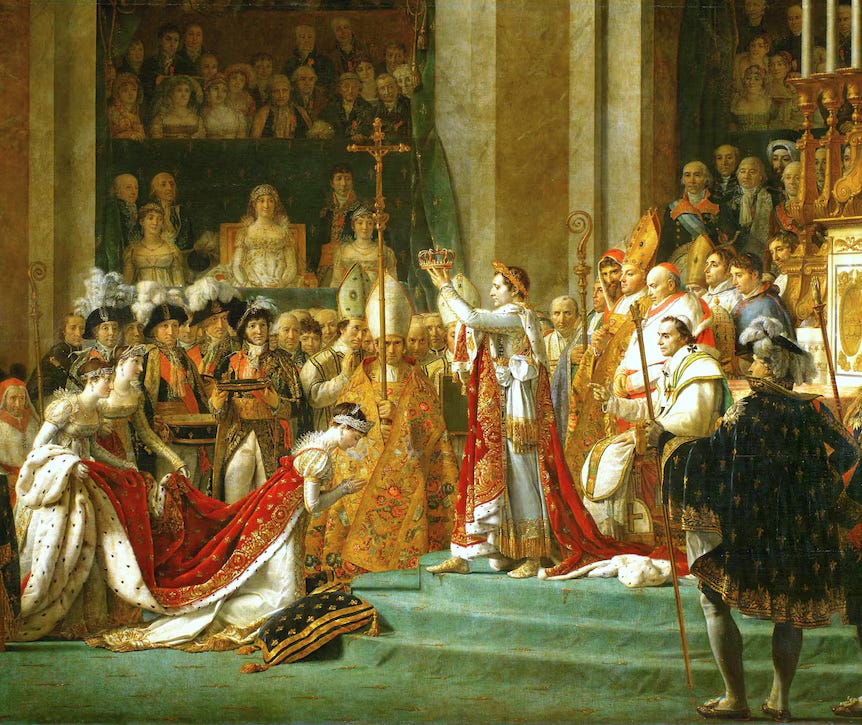
The cautionary tale that best illustrates where we actually are with Leo and Trump lies not in the fourteenth century but in the early nineteenth when Pius VII was pope and Napoleon Bonaparte was emperor.
Others have made Trump-Napoleon comparisons before: Jan-Werner Müller, for instance, asked last year whether “Caesarism — a term invented in the nineteenth century to describe Napoleon’s particular form of rule — [is] a good analogy for understanding Donald Trump?” The Trump-Leo, Napoleon-Pius VII comparison is instructive, nevertheless.
When Napoleon confronted Pius, he had already dragged his predecessor to France where Pius VI died in captivity. “One can die anywhere”, a pitiless French general had told the ailing, octogenarian pontiff, who had asked to be left alone to die in his bed. The cardinals had been forced to convene in Venice, not Rome, to elect Pius VI’s successor in 1800. The new pope took back his city, but only because the Jacobin republic installed there had proved even more fantastically unpopular than papal rule.
Napoleon made the Pius VII sign a largely unfavourable concordat that effectively transferred control over the French church to the state. Notoriously, he then summoned Pius to Paris where he was made to preside over Napoleon’s imperial coronation.
At the climactic moment, Napoleon snatched the crown from the pontiff’s hands, placing it on his own head. Pius had been used — and had been seen to be used. Within five years, he would be under house arrest at Fontainebleau, a second consecutive papal prisoner of the man he anointed.
Trump is not planning to march on Rome, or to capture Leo. Yet the structural logic of his conflict with Leo is remarkably similar to this earlier one. Like Pius, Leo commands immense symbolic capital but negligible hard power. Like Pius, he leads an institution that needs the goodwill of great powers — and yet must periodically defy them to maintain its credibility. And like Pius, he faces a “strong man” leader who cannot afford to be seen to be attacking the papal office directly, even as he clearly resents its occupant.
Trump, though a Protestant, is, by multiple accounts, genuinely impressed by papal prestige. And, like Napoleon — who relied on the church to reconcile conservative France to his rule after the upheavals of revolution — he needs American Catholics to see their faith and his politics as somehow being in harmony. They are a key group within his coalition.
Trump also understands how legitimacy is partly theatre. Leo’s decision to spend 4 July on Lampedusa rather than in the United States will not have been lost on the president. It is, in many ways, a magnificent, Napoleonic gesture of contempt — and one that may have raised the stakes beyond a level at which popes should feel comfortable to play.
Full of sound and fury
Pope Leo XIV looks, right now, like the winner of his encounter with Trump. Polite opinion across the West is very much on his side. Bernie Sanders endorsed Leo’s Easter message. Cory Booker praised his “moral clarity”. The Atlantic, The Nationand the Daily Beast have all treated him as a heroic figure for speaking truth to power. And yet the lessons of Pius VII’s confrontation with Napoleon ought not to be comfortable for either side in this neo-imperial controversy.
For Trump, the Napoleonic precedent is simply ruinous: the emperor’s imprisonment of Pius rallied Catholic Europe against him at precisely the moment he could least afford it and turned a cautious and partly compliant pope into a martyr. Trump may calculate that he can discredit Leo by painting him as a bleeding-heart critic of American power. He may even be right about the diagnosis. But the treatment won’t work. A pope who is visibly bullied becomes impossible to defeat in the court of public opinion. People respond to the papal office emotionally and instinctively, in ways that cut across political allegiance.
For Leo, however, the warnings begin with a tactical problem of his own making. Having now criticised Trump directly, he has broken a taboo — and taboos, once broken, lose their power. Each subsequent intervention will carry diminishing force. The pope is surely asking himself: was this the moment to sound that particular trumpet? Can he escalate if a graver crisis demands an even clearer moral verdict in the months ahead?
A deeper problem afflicts Leo, too — one that concerns not tactics but moral consistency. Iran is not a neutral party in this conflict, and it is certainly not a sympathetic one. It is a theocracy that executes its own citizens for demanding basic rights, and which funds and arms proxy forces responsible for thousands of civilian deaths across the Middle East. Iran has publicly committed itself to the elimination of Israel. Its closure of the Strait of Hormuz has inflicted potentially catastrophic damage on the global economy.
Leo has been notably (one might say, conspicuously) quieter on these matters than he has been on Trump’s rhetoric. The Babylon Bee, the conservative Christian satire site, called him out on this with characteristic bluntness: “Pope Condemns Allied Forces For Not Just Talking It Out With Nazis”. The Bee’s statement is a reductio ad absurdum, but it has real bite: for many consider strict and symmetrical pacifism — the position that war is always wrong and that dialogue is always possible — to be dangerously naïve.
Does the pope really think that the Iran situation can be solved through talks? If so, on what basis? Is he willing to spell out his reasoning in detail that others can critique? His predecessor, Pope Francis, was easily dismissed by his critics because he so rarely did this or represented opposing arguments with the kind of generosity that open debate demands.
As my friend Sam Rubinstein recently noted on social media, it is considerably easier to maintain Leo’s point of view from a position of complete powerlessness than from one of executive responsibility: “I wonder if this sort of strict and principled pacifism would be the position of the Catholic Church if it had any worldly power? Ah well, I suppose there’s no way of knowing.”
The high ground is easiest to reach for when you have no other ground to defend. To govern is to be forced to choose. And the Catholic Church, across its long history, has hardly been unwilling to choose force when doing so suited its institutional purposes — just ask those whom it has branded as “heretics”.
The unbearable lightness of being pontiff
Pope Leo XIV is an intelligent man, and there are signs that he understands the risks of the world he is moving into. The Catholic Church did not emerge from the Napoleonic era unscathed — another factor that ought to inform his thinking. It lost property, treasure and institutional dignity. The trauma of those long revolutionary years cast a dark shadow, making the papacy brittle and defensive at precisely the moments it needed to be supple (for instance, during the revolutions of 1848 and the Risorgimento).
There is no guarantee of coming through any better this time. Leo’s rebuke of Trump’s civilisation-ending rhetoric was not wrong; it was, arguably, the minimum the papal office demanded. But to speak carefully in one direction is still to speak in one direction. Caution in tone is not the same thing as wisdom in strategy.
Trump himself, whatever his many faults, pulled back from the brink, delaying military action and entering negotiations.
Leo might reflect on whether the most durable contribution he can make is to position himself as the conscience of one political tribe, or whether he might aspire to a harder and more valuable role: that of the genuinely impartial voice, trusted by all sides and therefore capable of being heard by them.
History, it should be said, does not offer many encouraging precedents for a pope playing that impartial role. Most popes who have tried to speak across the battle lines of their era have flunked the test, or been ignored, or both. Any pope who tells all parties what they do not want to hear is hardly likely to do better.
For Leo, the most hopeful figure in the papal tradition may, in fact, be the man whose name he chose to take. Leo XIII did manage to make the great powers of his day listen to him — but he did so not by positioning himself above their concerns. Rather, he engaged with them seriously, acknowledging real grievances on all sides and representing even the anticlerical and liberal traditions with a generosity that surprised their adherents.
That was a far harder thing to do than issuing beautiful condemnations. It is also a better model than Pius VII’s bruising — and, ultimately, deforming — confrontation with hegemonic power.
First published on ABC Religion & Ethics, 13 April 2026.