
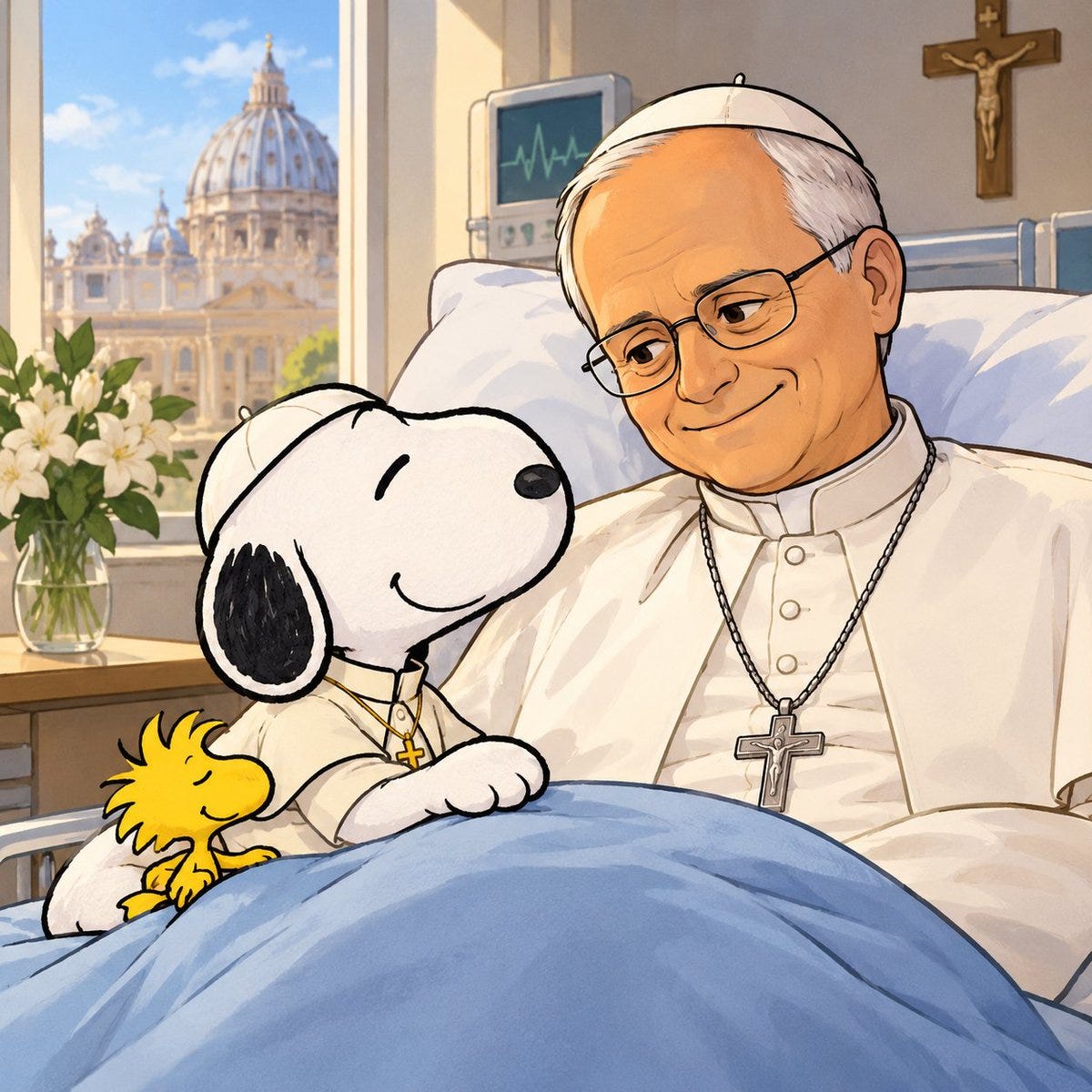
Pope Leo XIV, recovering in hospital in Rome last week, kept away from the cameras but still appeared in pictures. Fake images of him, wired to sickbed monitors but smiling serenely at the viewer, proliferated online — a new form of votive apparition vouchsafed by one of AI’s modern miracles.
Not even serious surgery can curtail the pope’s ministry, it seems. News that he had pleaded with Vladimir Putin for peace in Ukraine was greeted with an enthusiasm normally reserved for superheroes. Here is a pontiff who can endure cancer and still find time to confront the Kremlin. Rarely has he seemed less mortal or more muscular.
The modern Catholic imagination is peculiarly possessive of the pope’s physical person — at least, that is one reading of how people have responded to Leo’s infirmity. Conservative and progressive Catholic media agree on little else, but now find a certain fraternity in their anxious exegesis of his medical bulletins, blood test results, evidence of appetite and capacity for independent movement.
That Leo inspires such affection from all sides is a tribute to his immense personal appeal. And yet, amid the outpourings of good wishes and devotion, it is also hard not to wonder whether all this shades into a presumptuous claim upon his body. Concern for the pope’s health is one thing; an expectation of intimacy with his suffering quite another.
Early next month, Pope Leo still intends to travel to Argentina, where the growing cult around his person has an echo of the religious fervour with which the descamisados, the working-class supporters of Juan Perón’s regime, once venerated Argentina’s First Lady, “Evita”. Like Leo, Eva Perón embraced the poor, helped them, listened to their grievances and presented herself as their personal champion. When cancer consumed her, her followers watched her deteriorating health intensely.
The Catholic Church may not preach Peronism but the comparison with its devotions is uncomfortable precisely because the church has spent centuries insisting that its faithful depend not on the pope’s mortal frame but rather on a man who has already risen from the dead.
The late Jesuit historian John O’Malley once described “papalisation” as Catholic history’s great trend during the last half millennium — and he had in mind not only Rome’s steady embrace of authority but also its growing investment in making Catholics feel personally bound to the pope. The danger for Catholics is not that they love their pope too much, but that they ask him to carry a heavier cross than he can bear. A church that hangs on every blood test denies him the dignity of being ill in private — that much is obvious — but it also deprives itself of consolations that do not depend on his recovery or his visible presence.
The keys made flesh
Ordinary Catholics can hardly be blamed for feeling confused about what they should make of Pope Leo’s body. The church has spent centuries encouraging that confusion. The root of the problem is that popes die. Medieval kings, as Ernst Kantorowicz famously put it, possessed “two bodies”: a natural one that aged and a political one that proved immortal.
Popes, however, are different. For all their power over kings, they have no political body that outlives them. Their authority is a personal covenant, bestowed on them the moment they accept election. It expires with them. Popes are raised above other men, but they remain flesh and blood, destined to return to dust. The church managed this paradox for centuries by surrounding their physical person with grandeur: a triple tiara, and a portable throne carrying them above the throng. But the grandeur was not merely decorative. It was a way of saying that the man wearing the clothes mattered less than what he bore.
The same ceremonies that exalted the pope also took him apart. As each new pope was crowned, he was also shown a reed of burning flax. “Thus pass the glories of this world”, an attendant told him.
The contemporary Catholic Church has dispensed with this apparatus — not only the regalia but also the gestures of humiliation. It leaves the pope unadorned but unrebuked, and with much of the reverence once reserved for his office now settled on his person. Is it any wonder that we now make saints of almost every modern pope? Pius X, John XXIII, Paul VI and John Paul II have all been canonised. John Paul I has been beatified. Francis is likely also on his way.
Past ages were far more sparing. Before Pius X the most recent pope sainted was Pius V, who died in 1572. For most of the church’s history, a pope’s holiness was something to be proved after death, not demanded in life santo subito.
What remains?
The pope’s body might be sacred, but it was also never entirely his own. When living, it was subject to minute choreography, as well as intrusive surveillance by interested parties who wanted to know how long it would last in present guise. When dead, a pope could be subject to extraordinary indignities. The theologian Jacques de Vitry found the corpse of Innocent III — history’s most powerful and imperious pope — lying almost naked and decomposing in the summer heat in 1216. Pope Formosus’s remains were infamously dug up and put on trial at the Cadaver Synod in 897.
Veneration of the living pope began only really in the nineteenth century when Pius IX encouraged Catholics to collect and cherish images of him, even awarding them indulgences for praying for him. Pius made his own physical confinement as the “Prisoner of the Vatican” a symbol of their own religious and political grievances after 1870. In so doing, he encouraged Catholics to identify the church’s fortunes with his own body.
Twentieth-century popes soon found their bodies becoming media commodities. Pius XII, dying at Castel Gandolfo, was the greatest victim of this commodification. His physician photographed him in his final agonies and sold the pictures to the press in 1958. John Paul II, on the other hand, chose to bear public witness to his own suffering, letting the world see his decline. Benedict XVI shied away from that fate. He resigned because, in his own words, his “strength of mind and body” had deteriorated — one suspects that he did not want it to become apparent, nor be too lionised for it.
In Wadowice, John Paul’s birthplace, visitors can contemplate the bed, mattress and other furnishings from the room he occupied in the same Gemelli hospital where Leo was operated on this month. In Kraków, meanwhile, the bloodstained cassock he wore during the 1981 attempt on his life is preserved as a relic, alongside vials of his blood.
Such practices are more than mere celebrity worship. Christianity is an incarnational religion: its adherents have venerated saints’ bodies and relics for centuries. They invest physical objects associated with them with spiritual significance precisely because they bear the imprint of suffering, martyrdom and holiness.
Yet there is always a cost attached. Relics belong to the dead — to saints whose lives are complete and whose worthiness the church has judged. When they are anticipated in a living pope, his body risks becoming a shrine before its time: venerated but also scrutinised and treated as common property. And a living relic is easily reproduced. Today, it need not even be real to work its effect.
Seeing is believing
This brings us back to Pope Leo and his synthetic apparitions. The Vatican released photos of the pope celebrating mass during his convalescence. The whole world has now seen him emerge from the Gemelli and lead the Angelus, grateful, beaming. Yet what have Catholics actually learned from these appearances? Very little of Leo’s private experience of illness, I would venture. Every one of those images shows Leo doing what popes do: offering mass, leading prayers, blessing innocents. They are images not of man but of ministry. What Leo felt in those long hours on the ward, how he faced or embraced his fears, what the treatment has cost him physically or emotionally — those things remain his (and God’s) alone.
The synthetic images exist precisely to cross that line — whoever makes them, they find a ready audience among the faithful. They tantalise with an illusion of access which the real photos neither offer nor pretend to offer. The fabrication may be a stranger’s but the appetite for it is ours.
One irony is that Leo himself anticipated this earlier this year. He wrote in his celebrated “AI encyclical”, Magnifica Humanitas, not only that technology must serve human dignity but also that illness, ageing and vulnerability are not defects that await technological upgrades but places where care, fellowship and an openness to God can grow.
Leo’s body will remain contested for some time to come. But AI’s power to conjure an artificial Leo — endlessly available, conveniently reassuring and smiling through suffering — threatens the very thing Leo’s encyclical defends: a humanity “magnificent” precisely because it is more than just an emotionally satisfying fiction that projects others’ needs.
Who owns the pope’s body? The Catholic Church is owed an honest account of whether its leader can fulfil his duties. Its faithful may pray for him and seek inspiration in his example. But Leo’s body belongs to Leo. And one day, his Lord will ask for it back.
This piece was first published at ABC Religion & Ethics, 20 October 2026.